Apple Podcasts
 Podbean
 Spotify
 Amazon Music
 iHeartRadio
 Player.fm
 Podchaser
In this podcast we’re taking saxophone to a whole new dimension, as Joel talks to the incredible saxophonist, Jesse Bannister.
We’re discovering Indian saxophone with Jesse – a world-renowned performer and composer of Indian classical music.
And in today’s episode, Jesse breaks down a whole bunch of techniques that he’s developed over the years to incorporate saxophone into Indian music. These include his tonguing, his amazing fingering techniques, plus even some physical adjustments he’s done to his saxophone.

It’s really, really interesting. Just the way that he works out how to play a 22-note scale will blow your mind. So that’s all coming up for you today.
Just before we get started, though, if you are enjoying the episodes, we’ve been working super hard on them for you. It’d really help us out, though, if you could share it maybe with just one other person. It just would help us to reach more friends like you. Thanks a bunch. Okay, let’s dig into the episode.
Meet Jesse Bannister
Joel: Hi, Jesse, and welcome to the podcast. It’s great to have you here. How are you doing?
Jesse: Yeah, I’m doing great. Hi, Joel. It’s lovely to see you again.
Joel: Me and Jesse have known each other for nearly 30 years, which is a very long time, considering that we’re in our early 30s. We wish! Have you been busy? How’s, how’s life and playing and all that good stuff?
Jesse: Yeah, I’ve been really busy this last week. I’ve just been on tour with a sitarist called Niladri Kumar, just playing at Leicester Y Theatre and at Manchester Stoller Hall. And then I’ve been carrying on performing this week, which is great.

Joel: Brilliant. I mean, we’ve just said that we’ve known each other for 30 years. But we’ve taken very different paths in our music. There’s a lot of crossover, actually, and we’ll get to that. But can you tell the listeners a little bit about your career so far? And also why you picked this really specific avenue of music to explore on the saxophone?
Jesse: So I started playing saxophone at age 16, that’s when I started music. And I ended up going to music college at 18 or 19 to study jazz. I was really fascinated with John Coltrane and Sonny Rollins. I was born in London, so I was really keen to play edgy music and modal music.
And when I got to college the environment was very different. The curriculum was very different. And I met an Indian music teacher called Dharambir Singh, and I was really inspired to learn Indian music.

But prior to that, whilst I was raised by my father, my mother’s Indian. So there was, it was obviously something inside me that was driving me to move towards studying and playing Indian music.
Discovering Indian saxophone
Joel: So when did you make the decision to go full-on, in this direction? Was there a particular recording, or was it just the experience of playing the music?
Jesse: I think it was the opportunities that it was going to provide me in my career. Because I wasn’t at the level of the other jazz saxophonists around me, but with Indian saxophone music, I was being asked to do work. I was asked to play in ensembles and get involved in things.
So it kind of gradually just evolved. It wasn’t like a spark moment. But I would say going to India in 2000, which was eight years into my journey – that was probably that moment where I realised that I could do it. I was performing on big stages with the best Indian musicians and they were really encouraging me.

Immersed in Indian culture
Joel: So do you think it was really important, that you went and immersed yourself in the actual culture and the music, in the country the music was born in?
Jesse: Yeah, India is a fabulous place. When, when we go to a concert in India, it starts at seven at night and finishes at seven in the morning. And one artist might play for three or four hours and they’re only playing two pieces.

So you really get a sense of the presentation of the music. In the West, Indian music is presented in 45-minute chunks. And originally in the West, actually on HMV, can you imagine condensing a two-hour performance to three minutes? So there’s been an evolution and a sort of ‘backward-lution ‘as it were, in terms of Indian music, travelling from East to West.
But I would say living in Leeds and having grown up in London, the multicultural-ness of those cities has allowed me to learn and study Indian music actually in Leeds itself. So I’ve only done probably a total of 12 weeks of study in India itself, but the rest over many years has been in Leeds.
Joel: Right. Well, that must’ve been an amazing experience over there. Wow. That’s a long gig. That’s a long gig. I’ve got some gigs in my time, but I don’t think I’ve done one that long, I have to say.
Jesse: I mean, it allows you to take your time with things. With Indian music, we slowly reveal the story. We don’t sort of go straight into it. So that’s the nice thing as a musician and an improviser, that we get the chance to tell a story over a period of time.

Joel: I think I’d quite enjoy that actually.
Jesse: I think you would. I mean, I think that’s probably where Coltrane got this idea that he wanted to play these hugely long solos, because he realized that he wanted to hit the depth of something. When we practice the saxophone, we practice non-stop for two or three hours and we get to a point where it’s really just starting to warm up and happen. So to have that opportunity in front of an audience is a blessing.
The structure of Indian Music
Joel: Yeah, amazing. So, obviously, you went to college and studied jazz, and you’ve mentioned Coltrane and other players that were influences to you when you were younger. So how does Indian music work? Is it improvised or is it notated? Or is there kind of a chord structure, a bit like in jazz? Or is something else going on? How is it developed particularly over these really long concerts?
Jesse: Yeah, so there are two aspects. There’s melody and there’s rhythm – Rāga and Tala. So Rāga means to colour or to dye, so it’s the colour of the imagination.

The Rāga
So in a concert, if I was going to play a piece for, say, an hour, I would choose one Rāga – one main melodic structure, which would have five, six, seven, eight, or maybe 9 or 10 notes.
And so that Rāga has starting and stopping points, which give a real colour, to the mood. So you’re painting a picture. There’s literally an idea that you’re supposed to imbibe the essence or the feeling or the emotion of that particular melodic phrase or structure. And somehow through your instrument or your voice show the audience that this is a Rāga, which is almost like a living being.
So structurally Rāga has different forms within it. The first form is called alap, which is the introduction of the notes. So the musician, on their own with a drone, would either sing or play those particular phrases or notes.
And then after maybe half an hour, the artist would introduce the tabla player.
The Tala
So the tabla is the percussion instrument. And the tabla player plays in time cycles.
So the tala or rhythm aspect is a time cycle. It’s very similar to jazz or other song forms where there’s a fixed time structure. So the most common one is 16 beats, which is four sets of four. But you might play in seven, which is a three and a four.
So this idea of playing in odd meters, which is quite prevalent now in modern jazz, has come from Indian music, from the language.
So there’s this real mathematical perception of tāla with the feeling and a mathematical perception of the Rāga, the melody with the feeling as well.
Because there is no harmonic structure, rhythm and melody have to be really detailed. So as a musician, it gives us an opportunity as a soloist to develop that rich detail.
Comparison to modes
Joel: That’s really interesting. So there are a lot of parallels in some ways with jazz and it’s improvised. I suppose the Western equivalent maybe would be the modes to the Rāgas. Would you say that’s a good comparison – the different sounds?
I did a video recently in Sax School, which was all about Western musical structures. And I actually demonstrated all the modes with an Indian drone because it really starts to capture the essence and the vibe of that particular sound. I didn’t do it for 12 hours, but, you know, it was a shorter video than that.

So would you say it’s a similar thing? Obviously, it’s different, but from the point of view that they’ve all got their own sort of vibe and sound?
Jesse: Yeah, so the Rāgas definitely have the vibe and sound. The difference is that the scales or the modes, or what we call in Indian music, the thaat, is the starting point. So that would be the parent scale.
So, for example, if we were in C so we might have a rāga like this (listen as Jesse demonstrates).
This is the Dorian mode. And this scale, or this rāga – there’s at least a hundred different rāgas using these seven notes.
So this is afternoon rāga.
Whereas this is a late evening rāga.
Listen as Jesse demonstrates.
Jesse: so it’s just ever so slightly different inflexions, which create the mood of that particular rāga.
And in relation to the modes, Indian music and Greek music have the same origin. At some point, they shared musical knowledge through the modal system. And it went two different ways, essentially.
Microtones in Rāgas
Joel: That was amazing. I love that. Just beautiful sounds and I can feel myself in India just, just listening to that.
So do I understand correctly that there are some elements of some of these sounds – maybe Rāgas – that have slightly different tunings to the Western system?
Jesse: Yeah, if you sort of add up all of the Ragas, a simple way to see this is that there are 22 divisions of the octave. This is one scientific approach, but there are approaches which are non-scientific.
So the most common system is the 22 Shruti system. Shruti means microtones.
So for example, the major point of reference is actually the fifth, which is a ratio of 3 over 2, which relates to the Pythagorean tuning. And there’s also the major third, which is 5 over 4.
So the 5 over 4 major third is a lot flatter than the equal tempered major third. But also they have a sharper major third as well.
So the tonic and the fifth are fixed in Indian classical music. And then the other 10 notes have two positions, which give you 22 divisions of the octave. And of those positions, none of them relate to equal temperament.
Playing Indian saxophone
Joel: Ah. Really interesting. So obviously the saxophone is an instrument built in equal temperament. So, how do you go about getting these nuances and these 22 notes in the octave? Do you do that with your embouchure? Do you do it by pitching or bending? Or do you actually have to modify the instrument, or all of those things?
Jesse: Yeah, there’s, there’s, there’s four aspects actually. There’s the instrument modification, and there’s the pitch bending with the embouchure. Then there’s false fingering, and then there’s sliding to get to where you want to go which actually teaches you where the pitch is.
It is the sliding actually, which, is the key thing in the micro tonalities. You can’t say, ‘there’s that note, there’s that note, there’s that note’. It’s the way you approach it. You realize, ‘oh, I’ve found that feeling there.’ It’s when you arrive at a destination.
Sliding
Joel: So by sliding, do you mean slightly opening or closing tone holes, or do you mean actually just sliding the pitch by using a kind of bending it or something like that?
Jesse: Yeah, I mean maybe it’d be best to demonstrate.
So this is a drone which makes sure I play in tune, and the drone happens to be tuned to C. So if I want to slide to the flat second, on this particular saxophone, which is a mark VI, I just slowly open with the button B flat fingering.
Obviously, if I want to go from this saxophone B flat to the C sharp, so D flat concert to E natural, that’s a lot harder because that’s a bigger interval. So here I’m using side C to assist that process.
Because as I start opening without it, t here’s a point where the sound stops. So by using this at the beginning I can deal with that stopping of the sound.
At the moment you can hear it’s not perfect it’s not a perfect slide. And obviously, I can’t slide across the break. So there are limitations.
Indian saxophone modifications
Jesse: In terms of, in terms of the microtonality, I’ve added these little tuning screws. Dave Walker at All Brass and Woodwind added these for me.
Joel: So, these are just little screws and what are they doing? Are they just changing the height of the keys?

Jesse: Yeah. So there are six screws and they can affect the six main keys on the saxophone. So they don’t affect the side keys. They affect the B, the A and the G, the F, the E, and the D.
So if I show you on this B. I can still play B flat and it still acts in that way.
Joel: So you’re just opening or tightening a little screw on there.

Jesse: Yeah. And if I actually play in an open and tighten it, you’ll see the difference. It’s very subtle, but you can see the difference. For example, there’s an evening Rāga called Puriya Dhanashree, which has a much flatter second compared to other Rāgas. You wouldn’t find that in Western music. It just makes it stick out in a particular way.
Jesse’s set up for Indian saxophone
And so that’s really the only modification on the instrument. I’d say the modification was to me and my playing.
I use a very soft reed. I use a I use a two and a half reed, and I like to play it for days on end to get the right softness. And obviously, it’s just a standard C* ebonite mouthpiece.
There’s actually a saxophone technique that’s been really helpful. I’ve been playing this Rāga where it goes to the bottom C, but obviously, I don’t have it on the alto. Well, you actually put your leg over, but because I’m sitting cross-legged. It can be a little bit tricky.
Joel: Yeah. Yeah. So I’ve seen people do a similar thing. They put their knee down the bell when they’re stood up to get the low A.
Jesse: Exactly. And you can slide it. It does take a lot of effort.
But the main thing is just practising sliding patterns.
Fingering
Jesse: But also the other modification is the way I’m actually using my fingers. It’s very different to how a jazz saxophonist would do it. They’re much more feather-like. It might be similar to how an Eastern sax player would play an instrument.
Tonguing
And then there’s another Indian saxophone technique. The other techniques are particularly with the tongue. So there’s a, there’s a part of the Rāga called Jala, which is repeated notes. And that gets a lot faster to this point.
So I developed a technique – I was taught by Al Wood actually. He taught me a marching band technique, which he didn’t realize would be perfect for Indian music. And it’s basically where you tongue two notes. You go up the mouthpiece and then down. And so you have a group of four notes. And then from there, you can make different patterns.
Joel: I’ve come across that in some other concepts, sometimes called dooden tonguing. Oh yeah. And sometimes it’s just one of the varying types of double tonguing I suppose, but not in the classical sense with the bridge in the mouth. It’s very effective isn’t it, and very quick.
Jesse: Yeah, I don’t have to move my hands.You don’t have to do anything.
Joel: Brilliant. I think just just our shared history. Do you remember a student at the Leeds Conservatoire called Saffron?
Jesse: I do.
Joel: Did she have some lessons with you, maybe, at some point?
Jesse: She did, yeah. And, she went to India for three months.
Joel: She lived in one of the rooms, in one of my old houses. And she practised that tonguing technique every day, relentlessly, for an entire year. And she was blisteringly fast by the end of the year. I remember hearing its progress from being really slow with a metronome, about 30 BPM, to just being almost inaudibly fast, like a hummingbird’s wings. It’s a great technique. So it’s really, really interesting.
Jesse: When you first do it, you have to do it very slowly. Also, bear in mind, that your tongue will bleed at the beginning, not massively, but a little bit.
Joel: Well, that’s a warning for you folks. Be careful with that double-tonguing technique.
Jesse’s advice on playing Indian saxophone
Joel: So Just for the listeners, if this was something that a beginner or an intermediate player fancied getting into, what advice could you give them to get started with playing some Indian saxophone music? And what challenges might they face?
Jesse: I think the first thing is to put a drone on. I started by going to the piano and just playing a C and a G. Just banging it out and then just really immersing myself in that tonic and fifth and then just playing long notes over it. And then you’ll find these shapes and sounds. Because indie music is experimental. It’s an improvised form.
Originally it was found in nature, where there was obviously the hum of the forest and someone’s just singing and they’re expressing the colours and the movement that’s around them. So I would just be free and open with it.
So if you’re playing in a minor key – so you’re playing in C minor, what does it really feel like to play that F sharp, and where does that F sharp belong in relation to the G? Where does it belong in relation to the E flat?
Then you’ll find these varying intervals that are in Indian music. But you can also take the standard Western major and the standard minors and really feel the vibration of the note.
So our harmony is in note relationship, which we call tone.
Listen as Jesse demonstrates this.
Each is a note, but together they form a tone, in the sense of they form a colour. So when you’re playing, ask yourself ‘what note am I starting on and what note am I finishing on? Okay, what about if I started on a different note, but it’s finished on the same note’?
So then you’re making these tonal connections.
And if you’ve got a drone going on, you’re entering into a three-dimensional world. Because you’ve got a drone, you’ve got starting point, you’ve got ending point. So you’ve got these three moments, as it were. That would be a good way to do it.
Using Indian sax techniques in jazz
If you want to play like Coltrane, in terms of his sheets of sound, is to take any particular scale and play as if you’re drawing the Himalayas.
Listen as Jesse demonstrates
So I’m just seeing these pictures – these mountain peaks. I’m not having to think about the notes individually.
And I think because Coltrane had these lessons with Ravi Shankar and listened to a lot of Indian flute, he was able to grasp it very quickly in the way he wanted to. He was able to use it as a nice tool as a jazz player.
So you can play these huge sheets of sound. And when you’re doing it, you can connect the notes, or you might go, ‘okay, I’ve got seven notes there. Why don’t I miss one out? Or what shape does that make? Let me miss this one out instead.’
So you’re trying all of the combinations. And, that was really why Coltrane got into this idea of searching on a few notes, basically.

Challenges
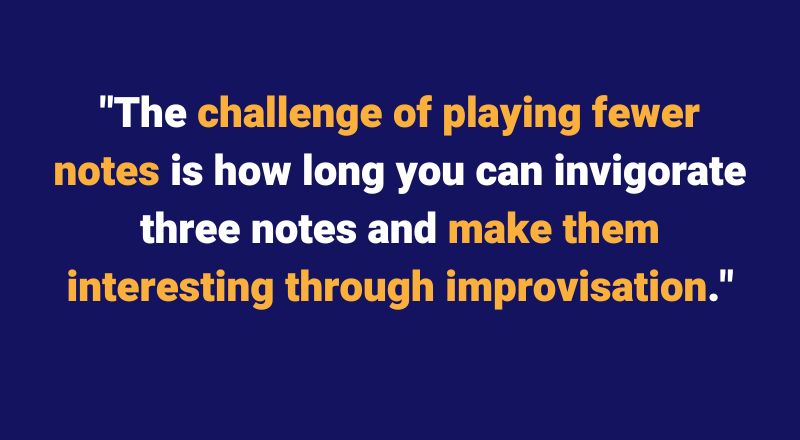
I think the challenge is boredom. The challenge of playing fewer notes is how much can you invigorate three notes. How long can you play three notes for? How long can you play a phrase that ends on the same note? And how interesting can you make that?
So, what I would say to alleviate that boredom, is to take an exercise where you play a phrase and then you play that phrase back exactly the same, but it’s improvised. You don’t make it fixed. So then what you’re doing is you’re catching yourself up and you kind of enter into this creative way of making this amazing geometric pattern.
Resources
Jesse: I think the challenge would be finding resources for Indian saxophone. With Indian music there are very few resources. And I think that there’s very little notated resources.
If you listen to some Indian music on YouTube, you’ll be able to hear the music. But you won’t find any particular notation that will satisfy you as a Western musician, I would say.
But I would invest in some drones. And then just play along with them.
Joel: Yeah, there are some really good websites that do drones, aren’t there? And some good apps as well.
That is really useful. Everything you’ve just said is almost exactly the kind of thing I talk about just in jazz improvisation, about exploring sounds and restrictive notes. So, it’s a very similar thing.
Transcribing
And, in fact, what you said towards the end about there not being a lot of notated resources – it’s just the same as jazz solos, and trying to learn that style. So, it’s about transcription. I think a lot of things always come back to transcription. It’s about listening and imitating and just finding the things you like and exploring the music, that you enjoy playing.
Jesse: Yeah, that’s a wonderful thought. Yeah. In Indian classical music, the main instrument is the voice. And what happens when there’s a vocal performance, there’ll be a harmonium player or a string player who copies exactly what they’re doing.
So they’re transcribing live on the spot, which is an interesting thing. If you listen to any vocal Indian music, have a listen out for the echo.
Joel: Okay, interesting. I will, I will check that out without a doubt.
What’s next for Jesse Bannister?
Joel: So what’s coming up for you in the future? Have you got any tours or collaborations that you can tell our listeners about so they can check it out?
Jesse: Yeah, I’m currently performing with Niladri Kumar. I’m playing at Leeds Howard Assembly Room. That’s in May. I’m due to go to India in December, or January. And then there’s going to be a tour, a national tour next year around March, or April.
Currently, I’m finishing my PhD, which is about sympathetic resonance. I’ve basically taken a grand piano and retuned it, and flipped it on its side. And I play the saxophone into it, which creates sympathetic resonance. Then I’ve recorded it, and removed the saxophone. So you’re just left with the string resonance. And that’s going to come out as a recording as well.
Joel: Brilliant. Actually, that’s something I love practising. I love putting a brick or my foot or whatever I’ve got under on the sustain pedal on a piano and just playing arpeggios into it, and just listening to it vibrate. It’s a lovely thing to do.
It’s just about exploring sound, isn’t it? That’s what we’ve been talking about as much as anything else today. It’s just that explorative mind of a musician just looking for sounds, and looking for a kind of beauty in music, really.
Jesse: Exactly. Yeah.
Joel: Brilliant. Well, thank you very much. It’s been fascinating just hearing about your journey so far with Indian music. And it’s great to learn about all the things that go on and what makes it sound like it sounds.
So I hope this has inspired some of our listeners to explore Indian saxophone and to check you out. And I’d just like to say thank you for coming on the podcast this week.
Jesse: Thank you, Joel, and I hope the listeners got something out of it, and good luck to you all.
Final thoughts
Wow, I really hope you enjoyed learning about Indian saxophone just as much as I did.
And if you’re not yet a member of Sax School, why not grab a free 14-day trial? Check out all the structured lessons and get help from our tutors. You’ll be amazed at how much you can help move your playing ahead, whether you’re just getting started on sax, coming back after a break, or even if you’re looking for pro tips. It’s all in there waiting for you, and that 14-day trial is free.
But for now, though, keep practising hard!