Apple Podcasts
 Podbean
 Spotify
 Amazon Music
 iHeartRadio
 Player.fm
 Podchaser
This is an Adolphe Sax vintage saxophone. It’s over a hundred years old, but is it even usable as an instrument today?
Let’s test this vintage saxophone together. Because, in this video, I’m going to show you what this 100 year old vintage saxophone sounds like. I’ll tell you what it feels like to play it, and also talk you through the sort of technical aspect of an older saxophone like this.
Tips on moving to a new sax
Plus, I’ve got some tips for you. I’ve got three things that will help you transition to a new saxophone, whether that’s a new or an old one. These tips will help you to get your playing skills up and running as fast as possible. It’s something most people get wrong, but we’re going to cover it in today’s lesson.
First of all though, let’s have another listen to this amazing, beautiful old vintage saxophone.

How I got to test this saxophone
Now, if you’ve watched my videos over the years, then you’ll know that I’m really more of a modern saxophone fan. I’m not really a big vintage sax guy. But when I came across this one, I definitely had to check it out and make a video for you guys too. So big shout out to Dave Walker over at All Brass and Woodwind in Leeds here in the UK.
This is the saxophone that he’s loaned me, and I love Dave’s work. Dave is an amazing saxophone designer. And in fact, if you haven’t checked it out, go see the video review I did of his Lineage tenor saxophone. It’s quite an amazing, modern, new design saxophone actually. But don’t go and check it out now. Finish here and then go check it out.

History of this vintage saxophone
So when I think about vintage saxophones, and maybe you’re the same, I think about maybe a Selmer Mark VI. These vintage models might be from the 1950s or 60s. Or maybe you think of an older Selmer SBA, from I guess the 1940s or 50s. You might even think of a Conn 10M or a Martin saxophone, and they might even be from the 1930s or the 40s. This saxophone, though, is quite a bit older than that.
Now, from what I can work out, this saxophone might even be from the 1890s. That means that this saxophone was designed, built and sold before the 20th century even happened. It might be older than any living person on the planet. That just blows my mind. And it also means this saxophone is actually older than Jazz .
Wow, that’s a crazy thought, particularly when you think that this saxophone can still be used today. We’re going to find that out a little bit later on.
How old is this saxophone?
So with these really old Adolphe saxophone instruments, the way that you can work out their age is by the address that’s printed on the bell. Because, that’s the address of the factory.
Now, I’m not an expert on this. I’ve just been doing some research. So if you know more about this, please do let me know in a comment.

This saxophone is marked as coming from 84 Rue Myrha. And from what I can understand, that address is the factory that happened right at the end of Adolphe Sax’s life. So he died in 1894, and was making saxophones from the 1840s, up until 1894 when he passed away. His son Adolphe Edward Sax Jr. took over the business.
He must have been a pretty clever camper because he ran that business through till 1928, when Selmer bought the entire operation. And that was the transition to the Selmer saxophones that we know today. That’s where it all came from. So that means this saxophone was produced somewhere between around 1890 and 1928. It could be 130 years old, which is absolutely amazing.
Now, the only other piece of information I have about this sax is printed on the bell here. It says number 309, and there’s no other serial number on this sax. Is it the 309th one that they made? I don’t know. I have seen other similar saxophones like this online with a much higher number on the bell. They also have a serial number, but there’s no serial number on this one. So again, I’m no expert. But I think it’s pretty safe to say it’s at least a hundred years old, and that’s absolutely incredible.
Technical Aspects and Playability
We’ve already heard how it plays, and it does sound lovely. I have to also say that the intonation on this saxophone, and the tuning, are amazing. I’ve played a lot of older old saxophones that are younger than this, but the intonation isn’t as good. For some reason, this one plays great. And not only that, the altissimo pops out really easily on the saxophone, and the overtones do as well.
In fact, I think the overtones and the altissimo are even easier on this than they are on my 1990s Dave Guardala tenor that I normally play, which is fascinating to me, actually.
Now, of course, this is an old vintage saxophone. So the system of the keywork is old. And the first thing you notice is this left-hand table key. Old vintage saxophones have this, and it’s kind of strange and uncomfortable, particularly compared to a modern saxophone. It definitely takes a bit of getting used to, so that you can move quickly between low Bb, B and C sharp.
The other really obvious thing is that there are no pads on the outside of the saxophone. The low Bb and B are on the inside of the bell and that’s weird when you’re playing seated because it’s not very comfortable, I don’t think.
Similarly, the D sharp pad on the back of the saxophone has quite a big guard on the back here. And so that feels quite strange when you’re playing standing up.
So ergonomically, it’s really not as comfortable as a modern saxophone. Also, there’s no adjustment on the thumb rest. That feels uncomfortable. And there’s no adjustment screws on this saxophone whatsoever. I guess that’s also a modern sax thing. Again, I’m no expert, right?
Now, of course, you’ve got no high F sharp on this saxophone, but you do have the alternate F sharp. I have to say, though, that the position of the keys and the weights of the keys is very different to a modern saxophone. And that makes playing fast passages a lot more challenging.
I’ll tell you what, though, the tone of the saxophone more than makes up for the trickiness of the key work. I absolutely love the sound of this vintage saxophone.

Tips for adapting to a new saxophone
Before we get into what this saxophone costs today, and whether I would even buy the saxophone, here are three things that you could do to quickly adapt to a new saxophone.
Whether you’re changing to an old vintage saxophone, or a new sax, these tips will help you.
So here’s the thing. Every saxophone, regardless of how much you spend on it, and how modern it is, is going to have its own quirks of tuning, and mechanism as well. So as a player, part of our job is really devoting some time to adapt to that new saxophone. It’s going to take time and we need to be systematic about it.
Otherwise, the transition to any new saxophone or old saxophone is always going to be problematic. We want to get back to being able to play as well as we can, as fast as possible.

Tuning
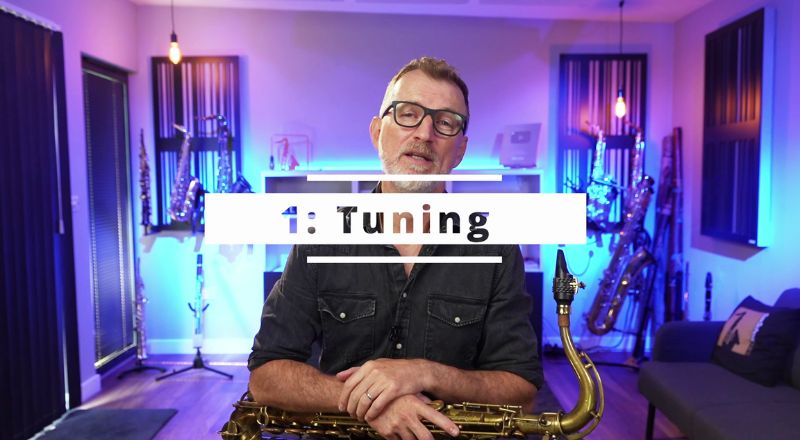
So the very first thing that I focus on is tuning. Now this is super important, because you could be moving to an older saxophone like this, where the tuning might be a little bit different to a modern sax. But equally, you could be moving from, say, my Dave Guardala sax, to a new Yanigasawa sax where the tuning is better. But it’s still going to be different, and so we need to adjust our ears so we know how to take advantage of the tuning of that saxophone.
So to do this, I spend a lot of time working with my tuner. And I’ll work on simple things like getting the middle range in tune, but then using the drone. I’ll show you what I mean.

Okay, so for example, this is the TE tuner app. There are tons of other apps, but I love this particular one. And by the way, if you want some tips on how to use this, I’ve got a great YouTube video on my blog here, where I run through a bunch of tuning tips that’ll help you.

So what I will do is put a drone on, and then I’ll play through with that, starting on low B flat. Then I move up to middle B flat, back down to low B flat. The I move up to second octave F, down to low B flat, up to second octave B flat. And I’ll work through a system like this to make sure that I’m locking in the intervals over the whole range of the saxophone. And that really helps to dial in my tuning.

Chromatic scales
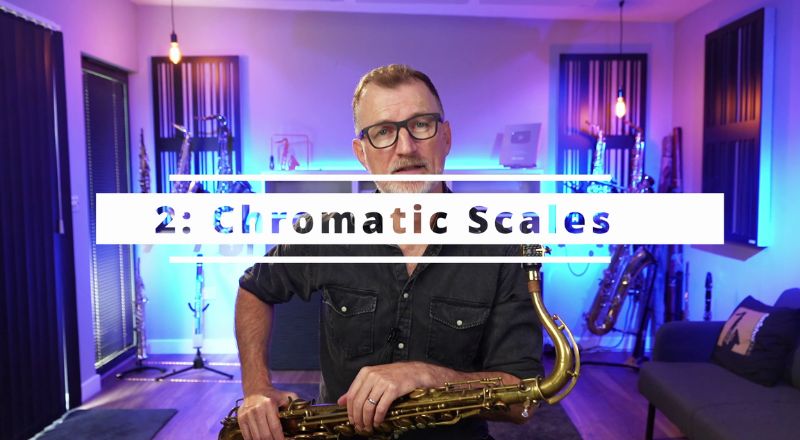
The second essential thing to work on is chromatic scales. Now chromatic scales are perfect for dialling in your fingers with the keywork of this new saxophone.
For example, on this saxophone, there are some keys that are quite heavy or in different places to what I’m used to. So I need to get my fingers used to that. Now there’s a video on my blog that’ll really help you with this. It’s called Seven Chromatic Workouts. Go check that out.

The trick, really, with chromatic scales is to work in five-note cells or groupings and focus on the areas that are tricky. For example, on this saxophone, I mentioned that the F sharp key is quite heavy, and so I’m finding my fingers are very clunky as I pass through that F sharp. So working on A five-note group of the chromatic scale that’s around that F sharp is really going to help me to iron that out.

Slow melodies
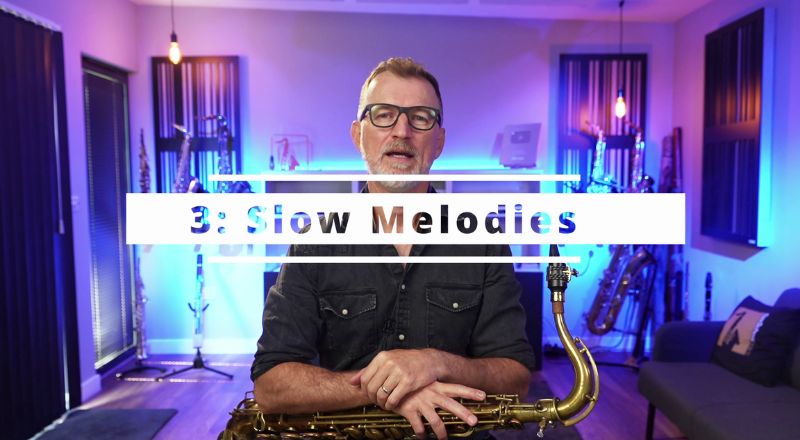
Now the final piece of the puzzle is working on slow melodies. So these are perfect for bringing all of your skills together and really getting used to the saxophone.
So it’s not just about how tricky the notes are to play. In fact, slow melodies are generally very easy to play in terms of getting the notes and the rhythms right. But we’re instead focusing on:
- your embouchure
- your throat
- your mouthpiece position
- your breathing
- your finger position
- the tension in your body
- how you’re connecting notes with the air
- how you’re using dynamics
- how you’re using vibrato.
With slow melodies you’re pulling all of these skills together to really make music and connect with those melodies. That’s the magic of them and the power of them.
So when you’re getting used to a new saxophone, definitely you want to be devoting some of your practice time to playing through simple slow melodies and thinking about how you can craft the whole performance.
It’s something that we can really help you with inside Sax School. There are loads of slow melodies in there and lessons on how to use them. It’s just part of being a member. If you’re curious to see how we’re helping thousands of people improve their playing using skills like this, then go grab the 14-day trial.

Versatility of this vintage saxophone
Now as I mentioned, the most amazing thing about this saxophone to me is it’s so versatile and it really does sound great. I could definitely imagine using this in a jazz setting or a blues setting. You could use it in a small band setting, even in a big band, and definitely playing solo if you’re playing with tracks.
With the right mouthpiece setup, you could probably even use it in a DJ sax setting. It wouldn’t be my first choice of horn for that, but I could see it would work. I wouldn’t choose this saxophone for doing a classical, symphony gig or playing in an orchestra or a small ensemble, just because the keywork makes it that much more challenging. I would probably focus on a more modern horn for that.
But if you think about the fact that this is potentially over one hundred years old and it’s still usable today – that makes it an amazing value-for-money saxophone. Speaking of which let’s talk about the cost of this sax.
How much does this vintage saxophone cost?
So I think at the moment, Dave Walker has this listed for about $3600 US, which is about £3000 in the UK. And if you think about how long this instrument has been used, it makes me think it’s probably going to last for another hundred years. So that’s pretty good value for money.

Would I buy this saxophone?
As I said at the start, I’m not really a vintage saxophone guy. I’m really more into modern horns. But this is one of the few vintage saxophones I’ve played that’s really opened my mind to the idea of something that just sounds so beautiful and is so different.
But if you love collecting saxophones and you want something that’s a little bit different, it’s got a very unique sound. It’s got that classic sound. And if you want to use it for a specific job, plus it’s got all that history about it, then I can imagine this would be a great choice for you.
What do you think about this saxophone? Would you like to see me trying out more different saxophones like this one?
But next, go and check out those video blogs I mentioned. So there’s the Seven Chromatic Workouts lesson and there’s also the tuning lesson.