Apple Podcasts
 Podbean
 Spotify
 Amazon Music
 iHeartRadio
 Player.fm
 Podchaser
The quickest way to get better on saxophone is to study great players and iconic solos.
And eighties alto sax solos can show us how great solos can be made with just one or two scales. That’s why I love digging into these solos with our thousands of students over at Sax School.
So here are 7 iconic eighties alto sax solos. They’re the ones that I grew up listening to. Maybe you remember these as well. Let’s kick off with this one.
#7 Candy Dulfer’s ‘Lily Was Here’
Okay, you’re probably not surprised this is the first one on my list. Candy Dulfer with Dave Stewart on the track Lily was Here. So classic. What’s really cool about this solo is that nearly the whole solo is based on just a single scale.
And that’s the C sharp blues scale. It’s these notes.

If we look at that very first line, it’s really obvious.
Then as she goes through the solo, there’s a couple of extra notes in there. But a lot of the really big flourishes are completely based on that blues scale. Check out this one.
Oh man, if we break that down, it’s amazing. And it’s all blues scale.
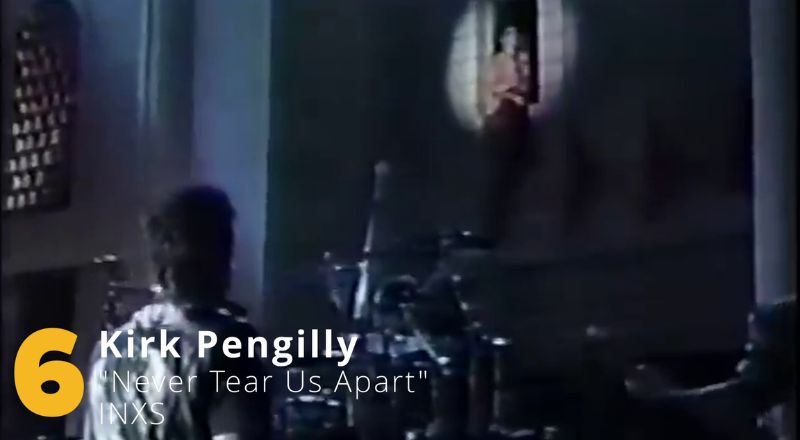

#6 Kirk Pengilly’s Blues Scale Mastery
Okay, let’s check out number six.
This is another great example of a blues scale. Kirk Pengilly there playing with INXS. You couldn’t help but hear this in the eighties in Australia.
But that line, what is it? So it’s starting on a C sharp then it goes straight down an F sharp blues scale, right? And he’s making it even more powerful with loads of growl.
Okay, that’s a powerful solo. It’s so simple and he’s using loads of growl all the way through there.
The simplicity of it though, I think is important. Because that’s one of the things that makes it so memorable and easy for us to sing along with, right?
Also, interesting, did you notice this mouthpiece? It’s a hard rubber mouthpiece. Most of the tenor players in this period were using metal mouthpieces.
Hey, by the way, if you want to check out some great tenor pop sax solos, I did a video on it recently – Find it here.
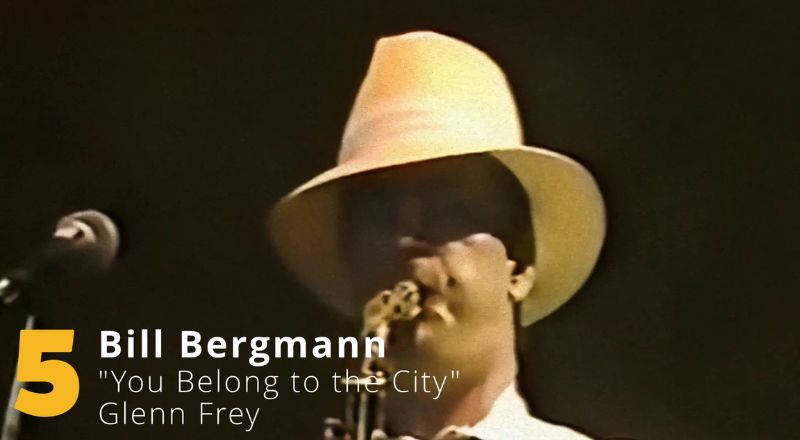

#5 Bill Bergmann’s “You Belong to the City”
Now what’s interesting for me with this track, is the opening line is so simple. And he brings it back, over and over all the way through the track.
But check out what he does in the solo.
Okay, some really classic lines that are happening in there. So what are the notes?
Does that sound familiar to you? Another blues scale. This time we’re in the key of C sharp for the alto sax.

Now that’s a classic line. So straight up and down a blues scale, and very similar to the sounds we heard in Lily Was Here, right?
So this solo is peppered with those blues scales. And if you’re just starting out with improvising, then blues scales can be a great technique to get you started.
Now, inside Sax School, I’ve got a whole course called Blues Mastery for Saxophone, where we talk about blues scales. And then also, an important thing, what’s the next step past blues scales? It’s something that most people forget about, but that’s an important part of that learning journey.

If that sounds right for you, grab that 14 day free trial to Sax School Pro. Blues Mastery is included with that. So you can dig in and explore the whole course.
Okay, I’ll bet that you’re going to know this next one. Have a listen.
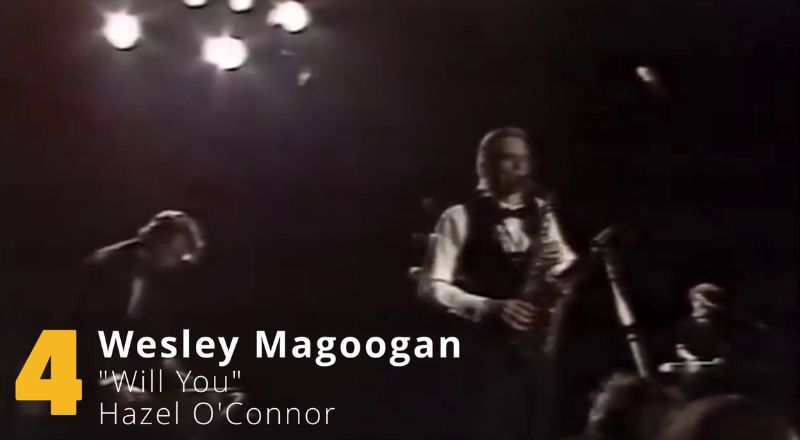

#4 Wesley Magoogan on ‘Will You’
Okay, so number 4 in my famous eighties alto sax solos is Wesley Magoogan playing Will You with Hazel O’Connor. Now, that’s such a popular track. It’s iconic. Our members in Sax School absolutely love it. You guys do love it, don’t you?
But I’ll let you in on a secret. It’s really not my favorite saxophone solo. I just find it a bit too bendy for me. But if you’d like to learn this style, then it’s interesting to look at what’s actually going on there.
Because he’s really playing his phrases really long and connecting everything together. And also his note choices are very simple. It’s almost entirely a B minor pentatonic, but he’s using a C sharp in there as well.

He’s doing lots of those bends and scoops and fall offs to connect everything together. Let’s check out the next bit.
That’s the stuff that I don’t like. The, all the “wow wow wow wow” – almost like a wailing type thing. And there’s lots of growling on the top as well.
Yeah, it’s very simplistic. But it’s cool, and it’s the sound. And if you like it, we do have a lesson on it inside Sax School.

#3 Rindy Ross in ‘Harden my Heart’
This is something completely different. This is Rindy Ross, playing the opening for Harden My Heart with Quarterflash. Man, such a great sound. Now hear how powerful her sound is? This is a different mouthpiece – she’s using a metal mouthpiece. I don’t know, is that an Otto Link? I’m not sure, let me know if you know what she’s playing on.
But it’s a really cool sound, and she’s using lots of growl in there as well. So what are the notes?
That’s really powerful. Unlike Wesley Magoogan, she’s really got lots of energy and force in the way she’s playing it. Every note is hit straight on, it’s full. It almost reminds me of someone like King Curtis maybe, the way they play on tenor – but she’s doing it on alto.
And the other cool thing about this particular line is it’s exactly the same line that comes back again and again throughout the solo. It’s a dead easy one to learn. And actually there’s a lesson on that inside Sax School too.
Now I’m saving my best, most favourite eighties alto sax solo for number one. You’re going to love it when we get there. But first, I’ve got something completely different for number two.
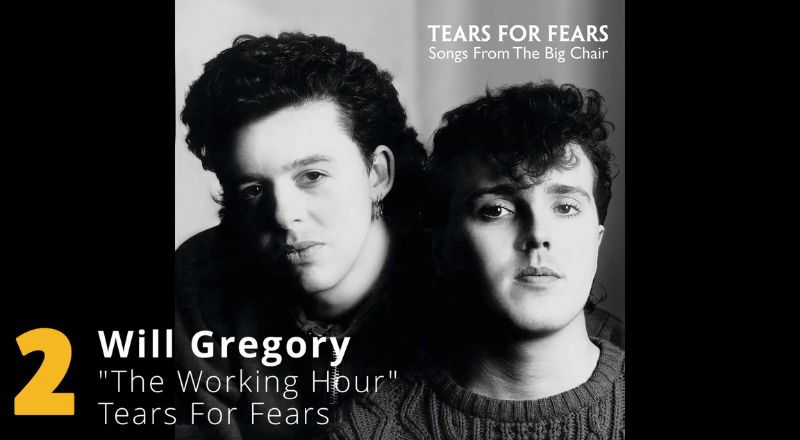

#2 Will Gregory in ‘The Working Hour’
How’s this for an iconic sax opening? So that’s Will Gregory playing the opening for The Working Hour with Tears for Fears.
Now what’s really cool about this line is it’s a different kind of sound to a lot of the other sax players we’ve heard today. It’s a much more forceful, almost a David Sanborn sort of sound.
But what about the note choices? Do you recognise them? It’s a pentatonic scale, right? So that’s the B flat pentatonic scale.

It’s pretty awesome to hear another artist using pentatonics in this style, but with a bit of a different twist to it.I love his sound.
Oh man, that’s such a standard sounding lick. And that last bit? He’s just adding the A into the B flat pentatonic. Very cool.
And another really cool pentatonic lick there.
All the way through this track, Will Gregory is using those pentatonic licks. This is definitely one to check out.
Okay, so I’ve saved my most favourite track for number one. Do you know what it is?
#1 Don Myrick in ‘One More Night’
Okay, now to my most favourite solo. I love this. This is Don Myrick’s solo, playing with Phil Collins on the track One More Night. Don Myrick is a legend. If you’re not familiar with him, he was with the Phenix Horns, so they did all the stuff with Earth, Wind and Fire as well.
Just have another listen to that first line and see if you can recognize the scale that’s going on there.
Alright, so it sounds really cool, but actually it’s just a C major pentatonic.

Listen as I play it with the grace notes back in.
I love this line later on in the solo.
I mean, that’s just an awesome line. And that’s, I think, what I love most about Don Myrick’s playing. He’s got that balance between having the sort of simplicity of the blue scales and the pentatonic scales and the great rhythm and tone. And he’s also got some fantastic language, because you can see that he’s expanding beyond these concepts as well.
Key Takeaways
And I think that’s the takeaway from all the videos today. It doesn’t need to be complicated. Remember, pentatonic scales and blues scales will give you a great head start with this sort of style. But of course there’s a lot of other things going on in there too, about the attitude, the dynamics, the little decorations in the playing as well.
And these are things we can help you with over at Sax School. But if you want to see what great tenor players are doing on these amazing solos in the 1980s, then go check out this next.