Apple Podcasts
 Podbean
 Spotify
 Amazon Music
 iHeartRadio
 Player.fm
 Podchaser
How to Play Every Note on Saxophone: A Beginner’s Guide
Learning to play every note on the saxophone can feel like an overwhelming challenge when you’re just starting. But with the right approach and tools, you’ll soon discover that mastering all the notes is not only achievable—it’s fun! In this guide, we’ll break down the essential steps to get you playing confidently and explain the techniques behind some of the trickier notes. Plus, we’ll share how you can grab our FREE Finger Chart to help you along the way.
Why a Finger Chart is Important
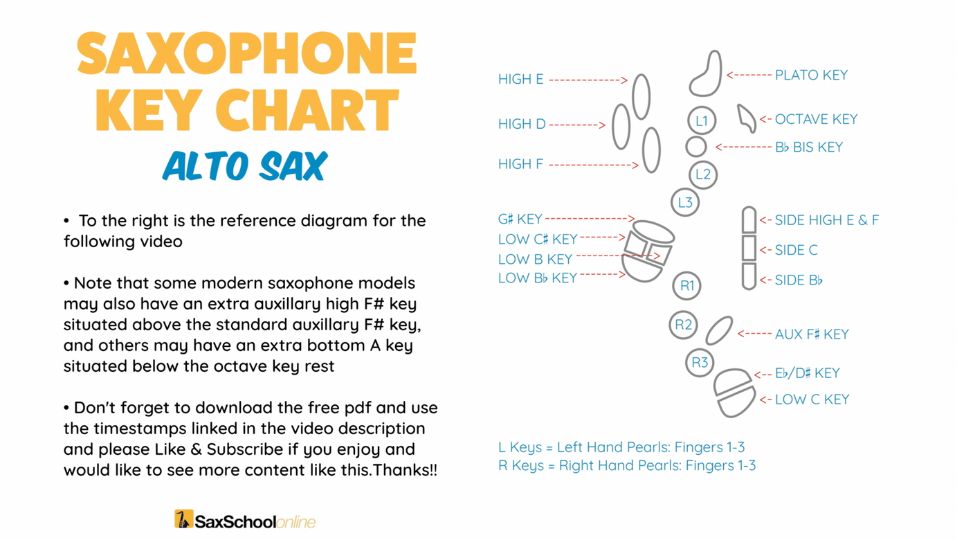
A finger chart is a saxophone player’s roadmap. It shows you exactly which keys to press for each note, providing a visual guide to proper finger placement. For beginners, it’s an invaluable tool because:
- It eliminates guesswork, so you can focus on sound and technique.
- It helps you build muscle memory for each note.
- It reinforces your understanding of the saxophone’s structure.
Make sure to keep a finger chart handy as you learn new notes—it’s your best companion for navigating the saxophone!
Which Notes Should You Start With?
When learning the saxophone, it’s best to start with notes in the middle range of the instrument. These are often easier to play because they require less precision with air support and embouchure.
Start with these notes:
- B, A, G (Left hand fingers only)
- C and D (Incorporating additional fingers)
Once you’re comfortable with these, you can expand to include notes in the higher register (using the octave key) and lower register.
Why Are Notes Written Two Ways (e.g., Flats vs. Sharps)?
As a saxophonist, you’ll often encounter notes written in two ways—either as a flat (♭) or a sharp (♯). For example, A♭ is the same note as G♯.
This happens because of the way music is written in different keys. While the sound of the note doesn’t change, its name depends on the context of the music you’re playing. Learning both names for each note is important because it will help you read sheet music more fluently and understand musical theory better.
Alternate Fingerings for Tricky Notes
Some notes on the saxophone can be played in multiple ways, depending on the musical situation. Here’s a closer look at a few:
Alternate Ways to Play B♭
- Standard B♭ Fingering: Add the A key with the bottom side key.
- Bis Key B♭: Use the small key between the B and A finger keys.
- Side Key B♭: In certain passages, using a side key can make transitions smoother.
Each method has its strengths, and your choice will depend on the piece you’re playing.
Alternate Ways to Play F♯
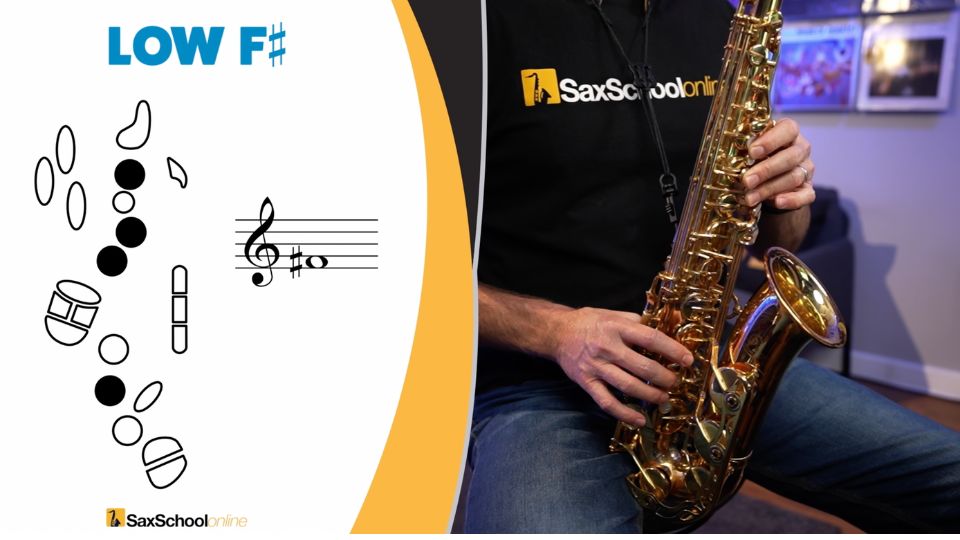
- Standard F♯ Fingering: Add the right-hand middle finger key to the F fingering.
- High F♯ Key (if your saxophone has one): This simplifies playing in the altissimo range.
Experiment with these options to see which works best in different contexts.
When to Use Side C Fingering
The side C fingering is a fantastic alternative for certain passages where the standard C fingering is awkward. It’s often used:
- In fast, technical runs.
- When transitioning to or from side key notes.
Mastering the side C option will make your playing more fluid and efficient.
Take Your Saxophone Playing to the Next Level
Learning every note on the saxophone is a journey, but with the right tools and techniques, you’ll get there faster than you think. To help you on your way, we’ve created an amazing FREE Lesson bundle that we call our Saxophone Tool Kit.
Inside the Tool Kit you’ll get a bundle of lessons to help you get playing fast including:
- Finger Chart
- Quick start to playing Saxophone
- Your first easy song
- The Saxophone Practice Formula
- 5 Minute Warmup Workout
- Quickstart to improvising on sax
👉Download Your Free Saxophone Tool Kit Here and start playing better today!
With practice, patience, and a little guidance, you’ll soon be navigating the entire range of your saxophone like a pro. Keep your workbook handy, and don’t hesitate to reach out to our Sax School Online community for support and inspiration. Happy playing!