Apple Podcasts
 Podbean
 Spotify
 Amazon Music
 iHeartRadio
 Player.fm
 Podchaser
There’s one simple reason why you struggle to play in time with a metronome or a backing track, and it’s not what you think.
Do you find it hard to play your sax in time with a backing track? Don’t worry, because today I’ve got a simple three-step process that you can put into action straight away. Try this to confidently play your sax in time with a backing track, a metronome, or even with a live band.
Step 1: Listening
So the very first step in this process is listening, and guess what? That’s actually the main reason why you’re struggling with backing tracks and metronomes anyway.
Now, hang on a minute. I know you’re probably thinking, “That’s way too easy, Nigel. It can’t be as simple as listening. I know how to listen. I’ve been doing it my whole life.” Let me explain.
Because it’s all to do with the way that you go about listening. So as musicians, we aren’t just listening. We really need to be doing active listening.
What is active listening?

What’s active listening? It’s simply focusing on all of the details of the music that’s going on around us.
Now, obviously, with a metronome, that’s important. but with a backing track, it’s absolutely important, it’s critical, just like it is when you’re playing with a live band.
Let me put on a track now that we’re going to use in today’s lesson and I’ll explain how it works.

Okay, so that’s a cool little melody. It’s called Swingin’ Easy. It’s from the Starter Pathway inside Sax School. And if you’re curious, you can check out the full lesson and all of our other courses. Plus, you can explore all of the advanced courses as well, and come to our live streams and get help from tutors – all that stuff. Get access with our a 14-day trial- click here.
When we’re learning a new piece of music and using a backing track, the first step is to actually listen to the backing track all the way through.
Now, I know a lot of you will fall into the trap of just focusing on the music first, and then thinking, “I’ll get to the backing track later”. And that’s when it all starts to go wrong.

So instead, if you’re using a backing track, I would start with the backing track first.
Now some of these tips will also help you with metronomes, but we’ll get to that in a minute.
When we go through and listen to our backing track, there’s a bunch of things that we should be listening to, apart from the overall feel and the energy and the beat and the rhythm of it.
Instruments
We also need to be listening to the elements that are inside that track. And the first of those elements is the instruments. What are the instruments what are they doing and how do they fit together? So let’s have a listen.

Okay. So we’ve got the saxophone on top.
Can you hear the bass? The bass is moving nicely and slowly.
What are the drums doing? Can you hear how clear the drums are? They’re really outlining every single beat.
So that’s the drums and the bass.
What’s the piano doing?
We can hear all those different levels in there. There are just three levels here, apart from the saxophone – the drums, the bass and the piano. And all of them are very clear about where the beat is. But the clearest beat is in the drums, in this particular style. That’s going to be really useful for us in a second.
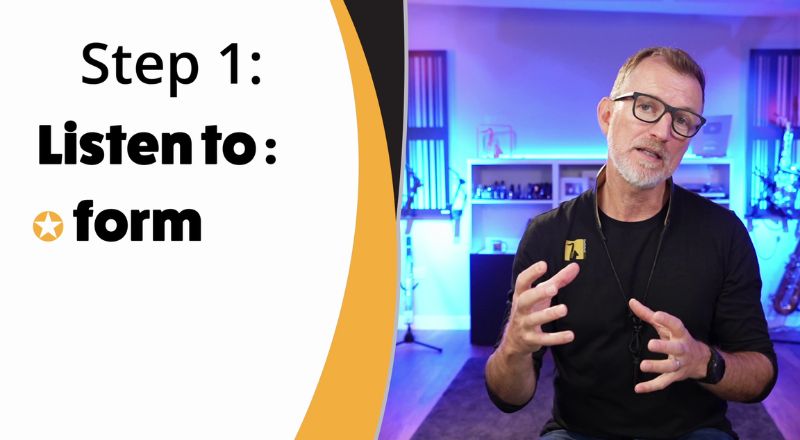

Form
Now the other thing that we need to listen to is what’s happening with the form of the piece. And what I mean by this is, can you identify the different sections in the track?
So we’ve just finished the first section. I’m going to back it up a bit. Can you hear when it goes into the next section? Let’s have a listen.
Okay, so this is the first section again. Sounds like a resolution there, doesn’t it?
Now we’re in a new section here, how the bass is different. It’s busier and the drums have changed. And the piano is busier.
Now what’s happening here?
Okay, now we’re back to the first section again.
So that’s quite interesting, right? You can hear how we change from section to section because the drums will change, the bass might change, the piano might change, and the energy can change. And that’s really important for us to identify, because those landmarks will help you play your sax in time with the backing track.
Okay, so that’s the first step of the process:
- listen to the backing track all the way through
- try to identify all the different instruments and textures in the track
- listen for the different sections of the track so you understand what’s going on with the arrangement.
- Find little landmarks that you can use later.
Now what about the second part of the process?

Step 2: Clap and sing
Now let’s be honest, you don’t stand a chance of locking in with the beat from the backing track unless you are actually listening to where that beat is. You need to be able to identify it without having the saxophone in your hand. It’s common sense, right? And it’s the same with a metronome.
So I’m going to pop the track on again and let’s see if we can clap along to the beat as we go.
Here we are. Can you feel that? That’s where the bass is landing (beats 1 and 3). but actually, if you listen to the drums, that’s where the beat is. One, two, three, four. That’s the end of the section.
Let’s keep going.
Now it might take you a little while to get that clapping right. And sometimes it’s hard to work out whether it’s half the speed or if it’s twice the speed. But if you listen to the whole texture, there are loads of clues in there. Where the melody starts, where the bass is moving, and what the drum is doing are really good clues. And you can hear in this track the drums moving on the beats on that faster tempo.

Sing
The next step is to see if we can sing the melody in time with the backing track. Now don’t worry, nobody else needs to hear this, right? It’s just you and your backing track. But being able to sing along with the backing track means that you are actually locked in. This will really help you play your sax in time.
I think you probably know the melody by now. I’m going to pop it back on and let’s see if we can sing along with it.
Now extra special credits if you can also clap the beat. Try it.
So how’d you get on? You can just rewind this section if you want to practice that again.
But I’ll give you one last thing to think about with this process. If you are clapping and singing, a really useful thing to try and do is identify which notes in your melody line up with the claps.

That’s really useful, because we can use that information to make sure that we’re right on track when we’re playing with our metronome or the backing track.
Ok, let’s talk about the third step in this process of how to play your sax in time with your backing track.
Step 3: Play in sections
Now would you believe it? Now is finally the time to pick up your saxophone and try playing along with the backing track. We’ve done all of our prep work, we’ve done our active listening, we’ve also done our clapping so we can really lock into the beat. Now it’s time to try to play your sax in time with that backing track to get the melody locked in.
You can make this process easier for yourself by slowing that backing track down if you need to if something is a bit challenging. And in Sax School, we’ve got a little controller on the player so that you can slow the tempo down. But you can also do it on YouTube, right?

However, what I would suggest at the start is to try just playing through one phrase at a time.
So play one phrase, and then rest out the second phrase. And then play the third phrase, and then rest out for the fourth phrase. That way you’ve got time in between the phrases to double-check that you are right.
Okay, I’m going to pop the track back on and let’s see if we can play it with the backing track.
Here we go.
Recording yourself

Now here’s a pro tip that will help you accelerate this whole process. And it’s simply recording yourself as you go along.
So you could use your phone. Just put your phone on and record yourself playing where you can also hear the backing track. Or if you’re using something like GarageBand you could record in along with the backing track that way.
What we’re listening for though is how our playing lines up with the backing track. If you’re using a Sax School lesson, you could also see how your saxophone lines up with my guide saxophone.
Now what’s super important here is you need to be very critical of yourself and really focus on the details of how well you play your sax in time with the original track.
You want to get it as accurate as possible, even if that means you need to just focus on one bar at a time. But trust me, accuracy here will really pay off.

Next Steps
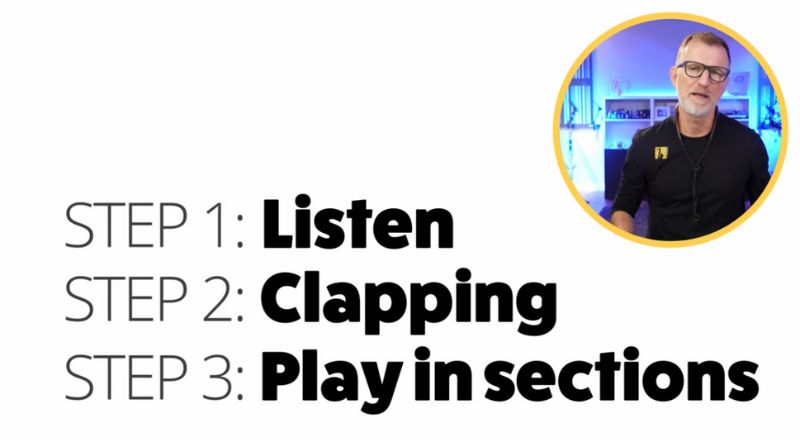
So that three-step process that we’ve learned here of listening, and then clapping, and then playing with the backing track in sections, will mean that you can now use this with every single piece that you work on from now moving forward.
In fact, I would encourage you to learn every single piece that comes with a backing track, with the backing track right from the beginning.
And now that you’ve got the timing sorted out, the next step is to really think about the quality of your sound. So go check out this lesson next to find out how you can boost your sound and get an even more beautiful tone on your saxophone.