Apple Podcasts
 Podbean
 Spotify
 Amazon Music
 iHeartRadio
 Player.fm
 Podchaser
So it was about big hair, and big shoulder pads, and big muscles, codpieces…Yeah, okay, we’ll come to that a bit later on! But the eighties were also about amazing saxophone solos in pop music.
Today we’re looking at 7 iconic eighties sax solos.
That first solo I just played? I’m going to break that down for you so stick around.
But first of all, Check out this one from Tim Capello in all his muscly glory. Okay, pretty much everybody is going to feel inadequate besides that guy.

Tim Capello: The Best
Tim Capello was the touring sax player for Tina Turner for years. Check him out in the video playing The Best.
Now he didn’t record that solo actually. The original one was recorded by Edgar Winter. And he’s just an astonishing saxophone player in this style.
What I think is interesting about the solo is, first of all, the melody of the solo is brilliant.
But secondly, the performance of it is amazing too. If we look at what’s going on in the music, it’s pretty simple, right? We’ve got quavers (or eighth notes) and, minims (or half notes.) It’s really just about playing it with energy and precision.

Fall-Offs
One of the things that really gives it that sound are the fall-offs that he’s doing. So he’s dropping his jaw to get those low notes.
I think the way Tim Capello does it, and actually in the Edgar Winter solo as well, is he really leans into those fall-offs to make them part of the whole shape.
The other fall-off that happens is a different kind. It’s one that he does with his fingers, and that’s later on in the solo. 
There, he’s doing a chromatic rundown with his fingers. So he’s going from that E, for example, down chromatically, as he releases his air and slows his air down.
So if you want some tips on getting that iconic sound of eighties sax solos, check out this video I’ve made on fall-offs which gives you a few more techniques that you can use to build up your skills with that.
Get the eighties sax solo transcriptions
Speaking of things to go check out, I’ve done a full transcription of all the eighties sax solos I’m going to talk about in today’s video. The link for that is below.
Now maybe Tim Capello didn’t record that solo originally, but he did with this one. Check this out this solo from We Don’t Need Another Hero.

We Don’t Need Another Hero
Now tell me you weren’t checking out his codpiece in that clip. What’s that all about?
Okay, so powerful. And again though, so simple. It’s just quavers or eighth notes all the way through. And there’s another one of those really cool fall-offs that are done with your jaw. So great!
Oh man, it’s a great reminder that you can make a simple, clear melody sound awesome if you play it with conviction.
Now, I’ve got something completely different. Check this one out.

Charlie DeChant: Maneater
So that’s Charlie DeChant playing the epic eighties sax solo solo on Man Eater with Hall Oates. Charlie did a masterclass for our members inside Sax School, which was really interesting. He talks about the process of recording that particular solo, coming up with the idea of the delay pedal, and the whole thing. It’s brilliant. Go check it out if you’re a member.
If you’re not a member though, there’s a 14-day trial running at the moment. Click here to get access.

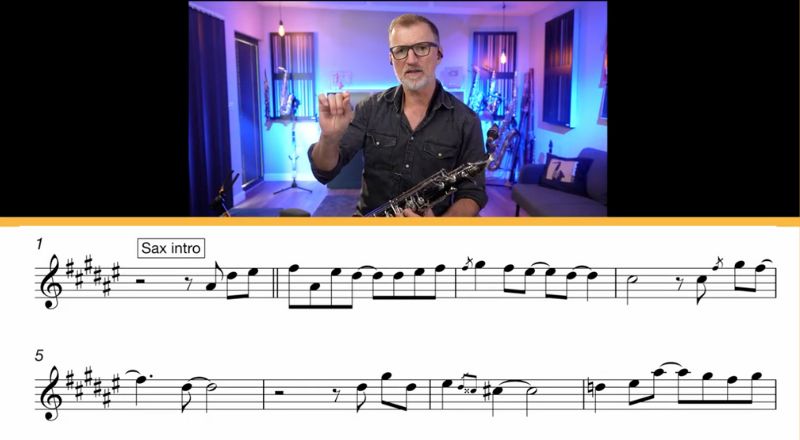
When you look at the music for this solo, it is also so simple. And what I really love is how it starts down low, simple, and then it builds in intensity, and complexity.

So if we start at the beginning, it’s with one note. And then two notes. Then three notes. Then four notes. And then we’re into the second register. Now we’re getting really high.
So that’s another fall-off, a bit like what we saw Tim Capello doing. But this time we’re using a chromatic rundown to go from the E to the C sharp.
And the solo just builds in intensity all the way through. He starts to get more percussive with articulations in there, staccato notes, that kind of thing.
And the other thing I wanted to say about Charlie DeChant is, that it’s funny seeing him straight after Tim Capello. Because Tim Capello is like the Mr. T of the saxophone world from the eighties, right? The muscles and the ponytail and the oiled-up and all that sort of stuff. And then Charlie DeChant, like the banker, right? With his floppy hair his suit and his glasses.
It’s really funny, but still really compelling.
I bet I don’t need to play you one more note and you’ll be able to tell me what solo this is, right? Everybody knows this. It’s like the sound of the eighties.

Stuart Matthewman: Smooth Operator
It’s Stuart Matthewman‘s solo on Smooth Operator for Sade. It really is one of those iconic eighties sax solos – right?
So it’s so different to what we heard from Tim Capello. Because now it’s really smooth, and a sensual sort of melody.
Stuart Matthewman is an interesting fellow because he also did drum programming and bass guitar for Sade on a bunch of her albums actually.
But he also co-produced and wrote tracks for Maxwell. In fact, he worked on Maxwell’s Urban Hang Suite, which is a mega album from around the late 90s.
Now, there are a couple of things to be careful of when you’re playing through the solo.

First of all, we really need to make sure we’re blowing right through the phrases to get it really smooth.That’s going to really connect the notes together and make it sound lovely and sensual.
The second thing to be careful of is the pick-up into the solo. Everyone struggles with this line. And to be honest with you, I was revisiting it recently. I used to think it was this [listen].
But I was listening to some live versions. In fact, the one that I just started playing before. And I think he does this [listen] – which is a little bit easier.
They’re groups four semiquavers (or sixteenths), but in a three-note pattern with a nice short note at the end.
So the important thing to focus on here, however you play that first line, is that you hit that F sharp at the start of the solo, right on beat one. That’s going to kick you off to a nice clean start for your solo.
Michael Brecker’s Iconic Solos

Oh, man, the first time I heard that I can remember it was 1985. I’m like 16 years old. That was the very first time I ever heard Michael Brecker. And I was in love. I mean, the sound is incredible.
Now, obviously, that wasn’t Michael Brecker that we’re looking at in the video. I know you’re all screaming at your computers and your phones at the moment!
That’s actually Nigel Hitchcock, who’s a genius British saxophone player. He’s been touring with Mark Knopfler for years. Actually, Nigel Hitchcock did some sessions for Sax School. He’s a phenomenal musician. He talks a lot about his sense of time in those masterclasses too. There’s honestly so much to learn. So if you are a member, go check that out. Don’t forget there’s a 14-day trial if you’re not a member.

Your Latest Trick
So this is Michael Brecker playing on Your Latest Trick with Dire Straits in 1985. And the magic of it really is the way he’s breathing and connecting all of the notes. It’s the details of the notes. So he’s breathing, his vibrato, the little inflexions on all the notes.
He really gets emotion out of every single note when he plays it. So think about using your air, breathing really deeply, pushing from right down low. And think about getting those important notes that are on the beat -right on the beat, so it completely locks in on time.
If you really want to dig into this solo, inside Sax School, I’ve created some lessons where I teach you this in an easier key. Because the original key is pretty horrible, it’s F sharp major or something stupid! So I’ll teach you in an easier key first, and that’s a fantastic bridge to then learning in the original key. And of course, you can get the full transcription.
The whole solo on the rest of this track is mega. But there’s another track which I think is a fantastic version of an eighties sax solo from Michael Brecker. Check this one out.
Candy with Cameo
Now did you know this track was in the eighties? Because growing up in Australia, I did not hear this song at all. I didn’t even hear it till the 2000s, I suppose, when I came to live in England.
But it’s such a great track. And if you’re interested in learning about Michael Brecker in this pop style, then the solo that’s included with the PDF for this lesson is definitely worth checking out.
There are a couple of really cool Brecker-isms in this solo. Check this line out, for example.

Oh man, I love that. If you listen to Brecker, he does that sort of thing all the time. And what’s happening here, is I’m going from F sharp to the overtone F sharp, which I’m playing with my low B fingering. Then I’m going to octave B, and then back to that overtone F sharp. And then C sharp, and back to that overtone.
The next phrase has a similar thing, actually. Check it out.
So what’s happening here, is when he hits the D sharp, he then goes to an overtone and then goes back on with the line. Woo!
Okay, that’s all in the transcription. Dig in. Honestly, there are months of things you could work on there.

Andy Hamilton with Duran Duran
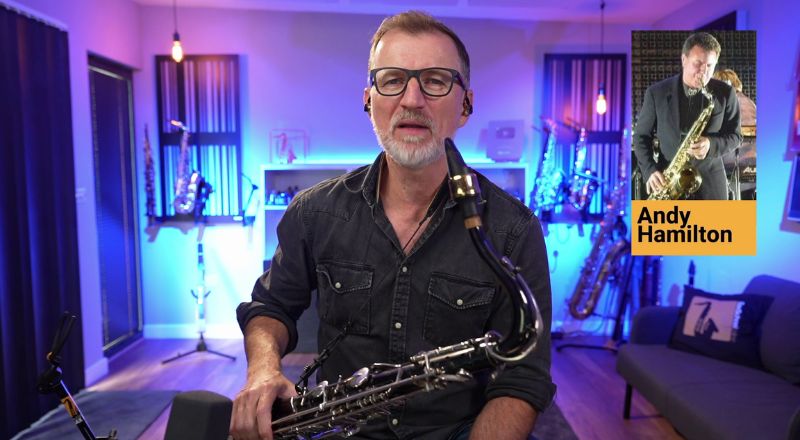
Next up, it’s Andy Hamilton playing with Duran Duran on that track Rio. My older sister was a massive Duran Duran fan. So this track was echoing around our house when I was a kid. What a great solo.
I love the pumping bass line in the band. I mean, it’s got such a great energy. It’s a different energy to what we heard with Tim Capello and Tina Turner, but still great.
If we’re playing this solo though, there’s two things to watch.
We’ve got to watch those triplets at the start. So we’ve got quarter notes or crotchet triplets all the way through this solo. And you can see even these first two notes are the second and third notes of a triplet. And he’s playing it with a real growl in it as well.

The other cool thing he does in this solo are those 16th note rhythms.
Let’s have a listen to the way Andy Hamilton does it.
So it’s a little bit different from the original recording> but what he’s doing, which I think is interesting for us, is articulating those 16th notes in a way that makes them easier to play. So rather than going ta ta ta ta ta ta ta ta, tonguing every single one of them, he’s going ta ta ha ta ha ta ha ta, ta ta ha ta ha ta ha ta.
And at the fast tempo you can then get your tongue around it more easily. Particularly me, I’ve got a slow tongue, right? So I struggle with this sort of stuff. So that’s a good little hack. Something to keep an eye out for.

Greg Hamm and Men at Work
Oh man, in the early eighties in Australia, you could not get away without hearing this song. It was absolutely everywhere.
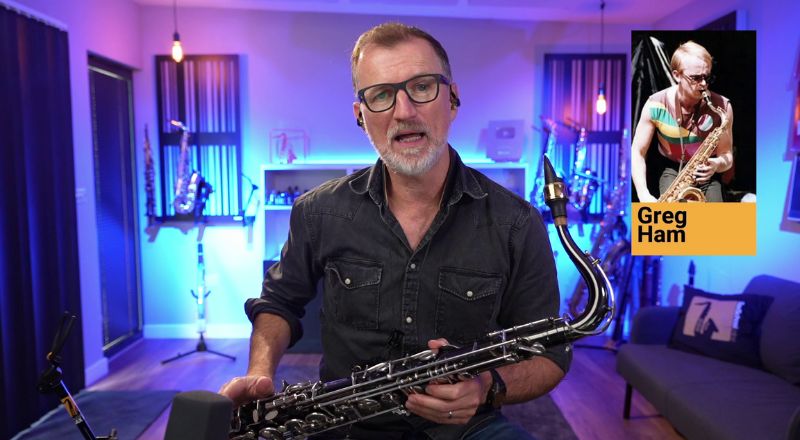
So this is Greg Hamm playing with Men at Work. Who Can It Be Now was the track. I think it was 1981 when it came out. Greg Hamm played with Men At Work for all those tracks. He also played the flute, like on that Down Under song.
This line is interesting to play as well because on the surface it sounds easier. There’s only, like, four notes in it, right?
But it’s actually a little bit tricky to get your fingers around, because we’re moving from E flat to B natural, B flat, high F sharp, and then back to B and to B flat.
So the trick around it here is to use an alternate fingering for our B flat. And the one that I find works the best is to use your B key plus your F sharp key on your right hand.
So I’m going from E flat here to this B flat fingering, then I can just take off my F sharp key to get to the B natural. And then I’m ready to go to the front F, so that’s these two plus the spatula key, and then either the F sharp key or the bottom side key for F sharp, and then back down to B, and B flat.

Woo! It’s a tricky little line, that one. You’ve definitely got to get your fingers around it slowly.
Now there’s a cracking solo in this tune as well, but it’s actually pretty simple. It uses simple note choices and simple rhythms, but it’s very, very percussive. So take your time in the transcription to work through that slowly. And if you can get it really accurate, then it’s going to sound as powerful as the original Greg Hamm recording.
Subscribe for more like this
Oh, by the way, if you’re enjoying this video so far and you’re not already a subscriber, then click that button and subscribe and give us a thumbs up or whatever. I’m making videos all the time. I’d love for you to come along on the journey with me.
Okay, no list of eighties sax solos and sax players is going to be complete without this next guy.
Clarence Clemons with Aretha Franklin
Okay, just those few notes – can you tell who that sax player is? Because for me, that’s so iconic. I can identify it straight away. Have another listen.
Of course, that’s Clarence Clemons. He’s playing with Aretha Franklin. And the track is Freeway of Love.

Now, I love hearing Clarence Clemons in this eighties pop scene. Because, for me, I can really hear all of that inspiration he got from the fifties and sixties R&B players – that big, fat sound.
So, what’s really cool about his playing is that it’s very percussive. It’s very simple, but it’s right on the beat. He’s just laying that melody out, and that’s why people can sing along with it. And it just feels so memorable.
So let’s have a look at music. It’s dead easy. It’s quavers or eighth notes all the way through.

So just like with Tim Capello, he’s got those big falloffs at the end of the phrases, and he’s doing that with his jaw. But also, everything is right on the beat.
I love it. The fall-offs make it, but also that staccato note toward the end of that phrase really gives the shape to the melody.
Oh, I love that. And check out what happens in the solo, because exactly the same things roll into the solo.

Man, I don’t know how he does that. That sound is just amazing for that eighties sax solo style. Check out the full transcription if you want to get up there. I’ve written it down the octave so it’s a little bit more manageable.
Have some fun with it anyway and let me know in a comment if you can get that Clarence Clemons sound.


Andy Snitzer: Waiting for a Star to Fall
Now I know I only said I was going to do seven people in this video. But I’ve got to do that solo I played one at the start, right? It’s one of my all-time favourite eighties sax solos. Check it out.
Okay. So that’s Andy Snitzer. And he’s playing Waiting for a Star to Fall. It’s with the band Boy Meets Girl. Such an iconic solo. And he’s a legendary player.
I mean, I met him back in the nineties when he was doing the Rolling Stones. He did a fantastic masterclass for our members, actually, inside Sax School, where he breaks down what it was like the day he went to the studio.
So he was working a day job at a bank. He came down, and took his suit off, and played this solo. Arif Mardin was the producer, he was like a big scary super-producer-type guy. The whole thing just came together and now it’s a mega hit. Incredible. Just goes to show how prepared he was for that particular setting.

The solo
So if we look at the solo, there are a couple of things we can think about.
First of all, it’s the breathing. We’re playing all the way through the phrases.
So we’ve got one of those big power fall-offs like we saw Clarence Clemons and Tim Capello do. And we’re also playing all the way through, pushing air all the way through that phrase to really connect it together.

The next phrase is quite complicated. There’s sixteenth note rhythms in there, or semiquavers.
But the next one is my favourite. This next line is brilliant. Have a listen.
What a killer line! I’ll play it for you slowly.
I mean, that is just mega. And to think he improvised that line the day he went in to record the solo is mindblowing, right?
So then we scream right up to the very high D, with another one of those big power falloffs. And another big power falloff at the end of that super high D.
Man, that solo is a masterclass in how you do a pop solo.
Next Steps
Oh, I tell you what, I’m exhausted. There’s only seven or eight eighties sax solos there. And I know there’s loads more we could have included on this list. So maybe I need to do another one of these videos. So if you’ve got a favourite eighties sax solo that I didn’t do today, let me know.
But for now, go check out this lesson to get some tips on how you can get those fall-offs sounding more convincing. I’ll catch you next time.